
The 15 Minute Huddle That Keeps Communication Training From Being Forgotten
Nov 07, 2026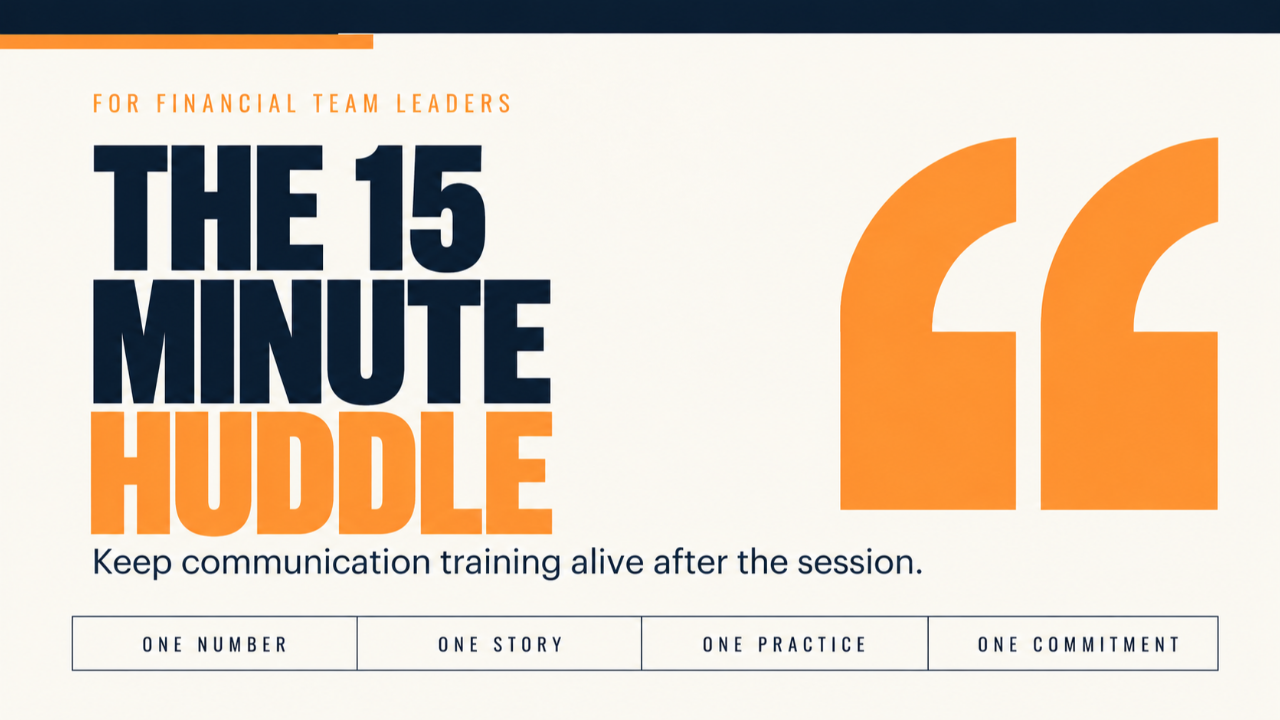
Your advisors enjoyed the training.
They took notes. They laughed. A few stayed afterward to ask questions.
You leave feeling good about the investment.
Then Tuesday happens.
The phones ring. A client needs paperwork. Someone misses a meeting. The calendar fills up, and the notes get buried.
Three weeks later, you ask what changed.
The answer gets a little uncomfortable.
If you lead financial advisors, you know how easily this happens. People can appreciate a session and still struggle to turn what they learned into something they consistently do.
That’s why the conversation after the training matters so much.
You need a place where the team practices, reports back, and decides what comes next.
Start with fifteen minutes.
Give the Learning a Place to Live
Throughout this series, we’ve explored the conversations behind acquisition, retention, expansion, and referrals.
For an individual advisor, the challenge is choosing a behavior and following through.
For a program manager or team leader, there’s another responsibility.
You have to make room for the behavior to become part of how the team works.
“Remember to ask better questions” sounds reasonable. But what does that look like on Thursday afternoon?
Which question? In what conversation? How will you know whether anyone tried it?
A weekly huddle gives those ideas a place on the calendar.
Keep it inside a meeting you already hold, if possible. Protect fifteen minutes. Use the same structure each week.
Familiarity makes it easier to prepare and harder to avoid.
Pick One Gap Your Team Recognizes
Don’t start by asking everyone to improve everything.
Choose one communication gap that matters to your team.
Maybe advisors are struggling to explain their value clearly.
Maybe too many households have gone months without personal contact.
Maybe discovery meetings produce plenty of account information but very little understanding of the person.
Start there.
Tell the team what you’re working on and why.
“For the next month, we’re focusing on reconnecting with clients we haven’t spoken with recently. Each week, we’ll practice an opening question and discuss what we learned.”
That’s specific enough for someone to act on.
It also gives the huddle a purpose beyond another reminder to communicate better.
Minutes 0 to 2: Put One Number on the Board
Open with the behavior you agreed to practice.
If your focus is reconnection, ask how many meaningful client conversations took place.
Keep attempted calls separate from completed conversations.
If your focus is referrals, track appropriate introduction conversations initiated. Keep that separate from introductions received.
If your focus is discovery, you might track meetings where advisors intentionally asked about the broader financial picture.
Define the measure before anyone reports it.
Otherwise, five people can give you five numbers that mean different things.
Keep the opening brief. Compare this week with last week and notice what needs discussion.
You’re looking for information that helps you coach.
Minutes 2 to 7: Hear One Specific Story
Choose one advisor to share a conversation from the week.
Ask:
“What did you try?”
“How did the client respond?”
“What did you learn?”
Encourage specifics.
“I asked better questions” is difficult for a teammate to use.
“I asked what had changed since our last conversation, and the client told me they were considering leaving their job” gives the room something to examine.
What made that question useful? What happened next? Where did the advisor feel unsure?
Rotate who shares. Assign the person in advance so they can prepare.
And protect client privacy. The team can learn from a conversation without hearing identifying details or sensitive financial information.
You also need stories about attempts that didn’t go smoothly.
An awkward moment can give your team something valuable to practice.
Minutes 7 to 12: Practice the Conversation
This is the part that’s easy to skip.
You’ve heard a story. You’ve offered encouragement. Everyone understands the idea.
But understanding a question and comfortably asking it are different things.
Use five minutes to practice.
Put advisors in pairs. Give them one realistic situation and one clear assignment.
For a discovery conversation:
“Your client mentions an account elsewhere. Ask about its purpose before asking about its balance.”
For a retention conversation:
“Your client says everything is fine. Practice one thoughtful follow up without pushing.”
For a referral conversation:
“Your client expresses appreciation. Ask what has been most useful about your work together.”
Let each person try. Then switch roles.
Ask the listener what felt natural and what felt rushed.
Keep the feedback focused on one thing the advisor can adjust. Five minutes won’t resolve every habit. It can make one conversation easier to begin.
Minutes 12 to 15: Name the Commitment
Finish with a clear commitment.
What will each advisor do before the next huddle?
“Be more intentional” needs another sentence.
“I’ll contact five clients I haven’t spoken with recently and ask what has changed” gives you something to revisit.
Have each person say their commitment aloud.
Then have them record it in the system your team uses to track work. Spoken commitments create clarity in the room. Written reminders help them survive the week.
Agree on a realistic scope.
An advisor who is overwhelmed may need to begin with two conversations. Another may be ready for five.
The commitment should stretch someone’s practice without becoming a number they say just to end the meeting.
Your Response Determines How Honest the Next Huddle Will Be
Someone will show up and say they didn’t do what they committed to.
What happens next matters.
If you embarrass them, you may get more impressive reports the following week. You may also get less useful information.
Ask what happened.
Was the commitment unclear? Did the advisor struggle with the language? Did urgent work crowd it out? Did they avoid it because the conversation felt uncomfortable?
Those answers require different coaching.
An advisor who needs practice won’t benefit from another speech about effort.
An advisor without time blocked may need help organizing the week.
Keep individual coaching individual when appropriate. Use the huddle to reinforce shared practice and honest learning.
That includes recognizing someone who tried a new question and learned something, even when no business resulted.
Don’t Confuse Activity With Results
A weekly huddle can help you see whether people are practicing.
It doesn’t prove that communication caused a change in revenue.
Keep behavior measures and business outcomes separate.
Track conversations initiated alongside referrals received.
Track outside assets identified separately from assets transferred.
Review business outcomes over a realistic period, with attention to the other factors involved.
That distinction makes your reporting more credible and your coaching more useful.
You can acknowledge progress without claiming more than the numbers tell you.
Put the First Huddle on the Calendar
You don’t need another hour on everyone’s schedule.
You need fifteen minutes with a clear purpose.
One number.
One story.
One practice.
One commitment.
Run it next week. Learn from what happens. Keep the structure consistent while you adjust the coaching to your team.
The final step in this series belongs to the leader willing to help people follow through.
Choose the gap. Make room to practice. Come back and ask what happened.
To identify where your team should begin, explore the Team Communication Audit and training options at Speak with People.
If you would like Jason to train your team, email him at [email protected]