STOP ASSUMING EVERYONE IS IN THE KNOW
Oct 10, 2026
The leadership communication mistake that quietly destroys clarity, alignment, and trust.
What if one of the biggest communication problems on your team isn't what people are saying, but what everyone assumes other people already know?
That question hit me pretty hard this week.
Twice.
Two different meetings. Two different situations. One painfully familiar leadership mistake.
I assumed everyone was in the know.
And I was wrong.
In the first situation, I found myself on a Zoom call walking through a proposal. I had been involved in the process, understood the details, and assumed everything had already been approved.
So I jumped right in.
It didn't take long to realize that not everyone was operating with the same information. What I thought was settled wasn't necessarily settled. What I thought everyone understood wasn't necessarily understood.
Ouch.
Then it happened again.
In another meeting, I was responsible for executing a plan I hadn't originally created. I had been communicating about the plan, coordinating details, and helping move things forward.
Because I understood the plan, I assumed everyone else did too.
Wrong again.
And here's what bothered me most.
These weren't situations where I wasn't communicating. I was communicating! But I had confused my knowledge of the situation with everyone else's understanding of it.
I was moving the conversation forward without making sure everyone was starting from the same place.
That's a dangerous leadership habit.
And I wonder how many of us are doing it every single day.
The Hidden Cost of Assuming Everyone Knows
Here's a statistic that should get every leader's attention.
According to Gallup's May 2026 employee engagement data, only 49% of U.S. employees strongly agree they know what is expected of them at work.
Think about that.
Less than half strongly agree they have clarity about what's expected of them.
And the consequences can be significant.
Gallup and Workhuman research found that employees who strongly agree they know what's expected of them are 47% less likely to experience frequent burnout.
Clarity isn't just a nice leadership characteristic. It matters to the wellbeing of the people we're leading.
When people lack clarity, confusion grows. Priorities get mixed up. Work gets repeated. Decisions get questioned. Frustration builds.
And eventually, trust can take a hit.
The uncomfortable reality?
Sometimes the confusion we complain about as leaders is the confusion we've unintentionally helped create.
A Leadership Lesson I Wish I'd Learned Sooner
Leadership author Patrick Lencioni describes effective leaders as "CROs (Chief Reminding Officers)."
I love that.
Not just Chief Executive Officers. Chief Reminding Officers.
Leaders who understand that important information needs to be communicated, reinforced, and clarified.
That doesn't mean repeating the same information mindlessly or turning every meeting into a history lesson.
It means recognizing that people enter conversations with different levels of context.
Some helped make the decision. Others only heard about it yesterday. Some understand the big picture. Others are still trying to figure out why the meeting was called.
That's why I'm learning to ask a better question.
Not just, "Have I communicated this?" but "Does everyone who needs to know actually understand?"
That distinction has led me to a simple framework I'm calling K.N.O.W.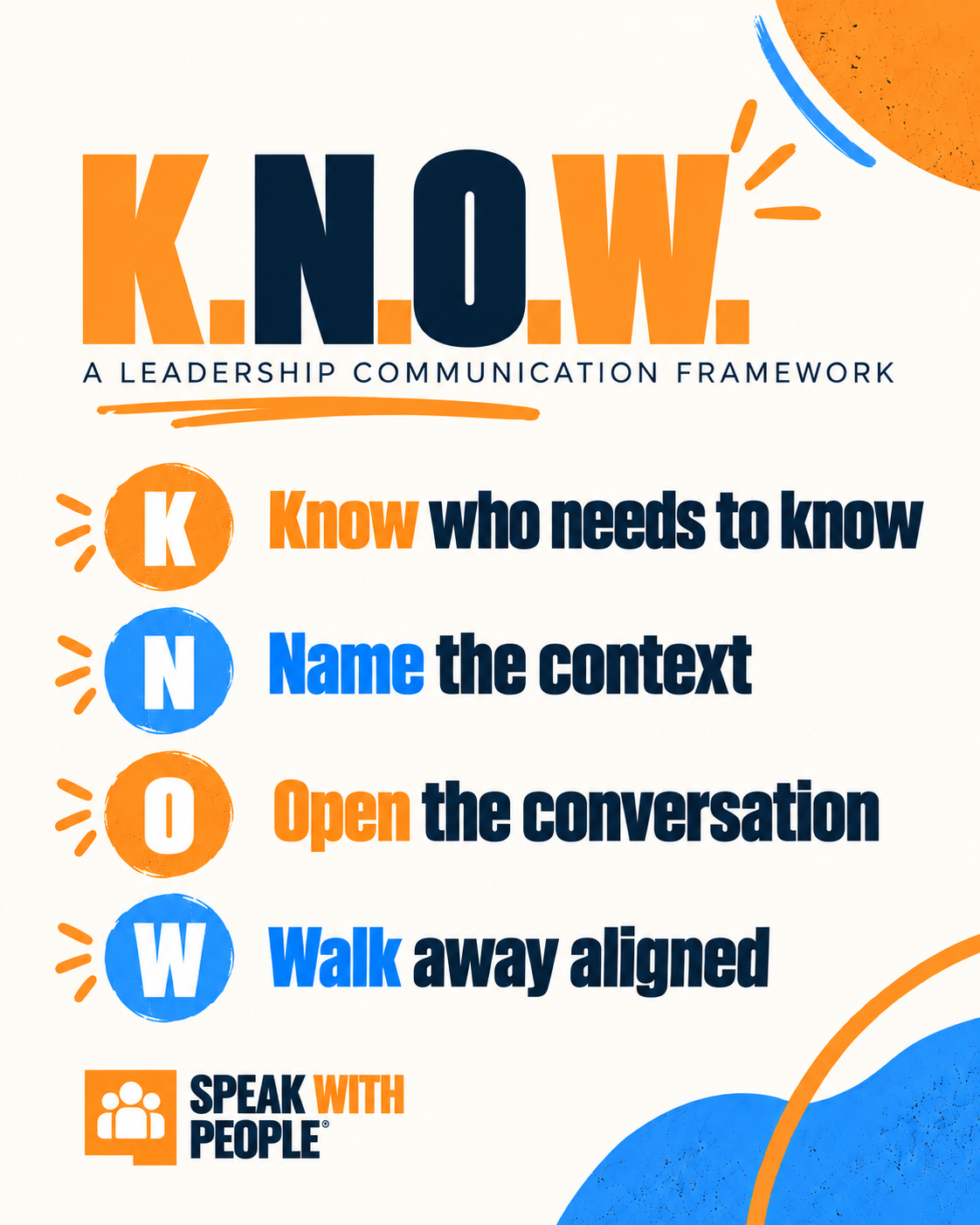
The K.N.O.W. Framework: Four Ways Leaders Create Clarity
K — Know Who Needs to Know
Before communicating the plan, identify who actually needs the information.
This sounds obvious, but it's where so many communication breakdowns begin.
We assume the person who made the decision informed everyone else. We assume the email was forwarded. We assume everyone attended the previous meeting. We assume the person responsible for execution was included in the original conversation.
And sometimes none of those assumptions are true.
Knowing who needs to know means thinking beyond the people who are already involved.
Who is making the decision? Who is executing it? Who will be affected? Who needs to approve it? Who needs enough context to support it?
Leadership question: Who could be impacted by this decision but hasn't been included in the conversation?
N — Name the Context
This is probably my biggest lesson from the week.
Before you jump into the details, give people the story behind the conversation.
Why are we here? What problem are we trying to solve? How did we get to this point? What's been approved, and what hasn't?
And yes, I know this may drive some of my high D, get-to-the-point leadership friends absolutely crazy!
I get it. I don't want to waste anyone's time either.
But I've learned something.
Sometimes you have to slow down the conversation to speed up the progress.
A two-minute overview can prevent a twenty-minute misunderstanding or hours of unnecessary follow-up.
Context doesn't have to be complicated. It just has to be intentional.
Leadership question: Have I given everyone enough background to understand why this conversation matters?
O — Open the Conversation
Here's another mistake I've made.
I've asked, "Does everyone understand?"
And when nobody responds, I assume the answer is yes.
But silence isn't always understanding.
Sometimes people don't want to look uninformed. Sometimes they aren't comfortable challenging an assumption. Sometimes they don't even know what questions to ask.
Healthy communication requires more than broadcasting information. It requires inviting people into the conversation.
Instead of simply asking if everyone understands, try asking:
"What am I missing?"
"What questions haven't we answered?"
"Does anyone have a different understanding of where we are?"
"What concerns should we address before moving forward?"
Those questions create opportunities for people to speak WITH us instead of simply being spoken AT.
Leadership question: Am I creating space for understanding, or am I just looking for permission to move on?
W — Walk Away Aligned
A great meeting isn't measured by how much information was shared.
It's measured by what people understand and what happens next.
Before everyone leaves, get clear about what's been decided, who's responsible, what's still unresolved, and when the next action needs to happen.
And here's an important distinction.
Agreement and alignment aren't necessarily the same thing.
People can agree that something sounds good without understanding what they're supposed to do.
They can nod throughout a meeting and walk away with completely different interpretations of the next step.
That's why I want to make it a habit to close conversations with a simple question:
"Before we leave, can we make sure we're all walking away with the same understanding?"
Then confirm the decisions, owners, deadlines, and communication responsibilities.
Leadership question: Can everyone clearly articulate what happens next and who's responsible?
Here's What I'm Changing
I'm not suggesting every meeting needs another fifteen minutes of explanation.
Please, no! We have enough meetings already.
I'm talking about being more intentional with the first few minutes and the last few minutes.
Start with context. End with clarity.
I'm learning that even when I'm not the decision-maker, I still have a responsibility to communicate clearly when I'm the person helping execute the decision.
I may not own the original idea. I may not have made every decision. But I can help make sure people understand where things stand.
Because leadership isn't about proving how much we know.
It's about helping people move forward together.
The K.N.O.W. Challenge: Try This in Your Next Three Meetings
I want to challenge you to do something practical this week.
In your next three meetings, take two minutes at the beginning to establish context and two minutes at the end to confirm alignment.
At the beginning, say:
"Before we jump in, I want to make sure we're all in the know. Here's why we're here, how we got to this point, and what we're hoping to accomplish."
At the end, say:
"Before we wrap up, let's make sure we're aligned on what we've decided, what still needs to happen, and who's responsible."
That's it.
Four intentional minutes.
Then pay attention.
Do people ask better questions? Do misunderstandings surface earlier? Are follow-up conversations more productive? Does your team leave with greater confidence about what comes next?
And if you discover that someone wasn't in the know, don't immediately blame them for missing the information.
Ask yourself how you can make the communication process better.
Because leaders don't just share information.
Great leaders take responsibility for creating understanding.
I learned that twice this week, and I suspect I'll keep learning it.
But here's the sentence I want to leave you with.
Don't confuse being in the know with making sure everyone else is.
Healthy communication is oxygen.
And sometimes the most important thing you can do as a leader is make sure everyone in the room has enough of it to move forward together.
Your challenge: Think about one decision, project, or plan currently moving through your organization. Who might be operating without the full picture?
Find that person. Start the conversation. Close the gap.
Because the next communication breakdown you prevent might be more valuable than the next meeting you schedule.
Jason Raitz is the founder of Speak with People, helping leaders communicate WITH people, not AT them. Through speaking, training, and the Speak with People Podcast, he equips leaders to build trust, strengthen relationships, and create healthier communication.
Better conversations. Stronger leaders. Healthier organizations.